Platform on architecture, interior design and landscape architecture
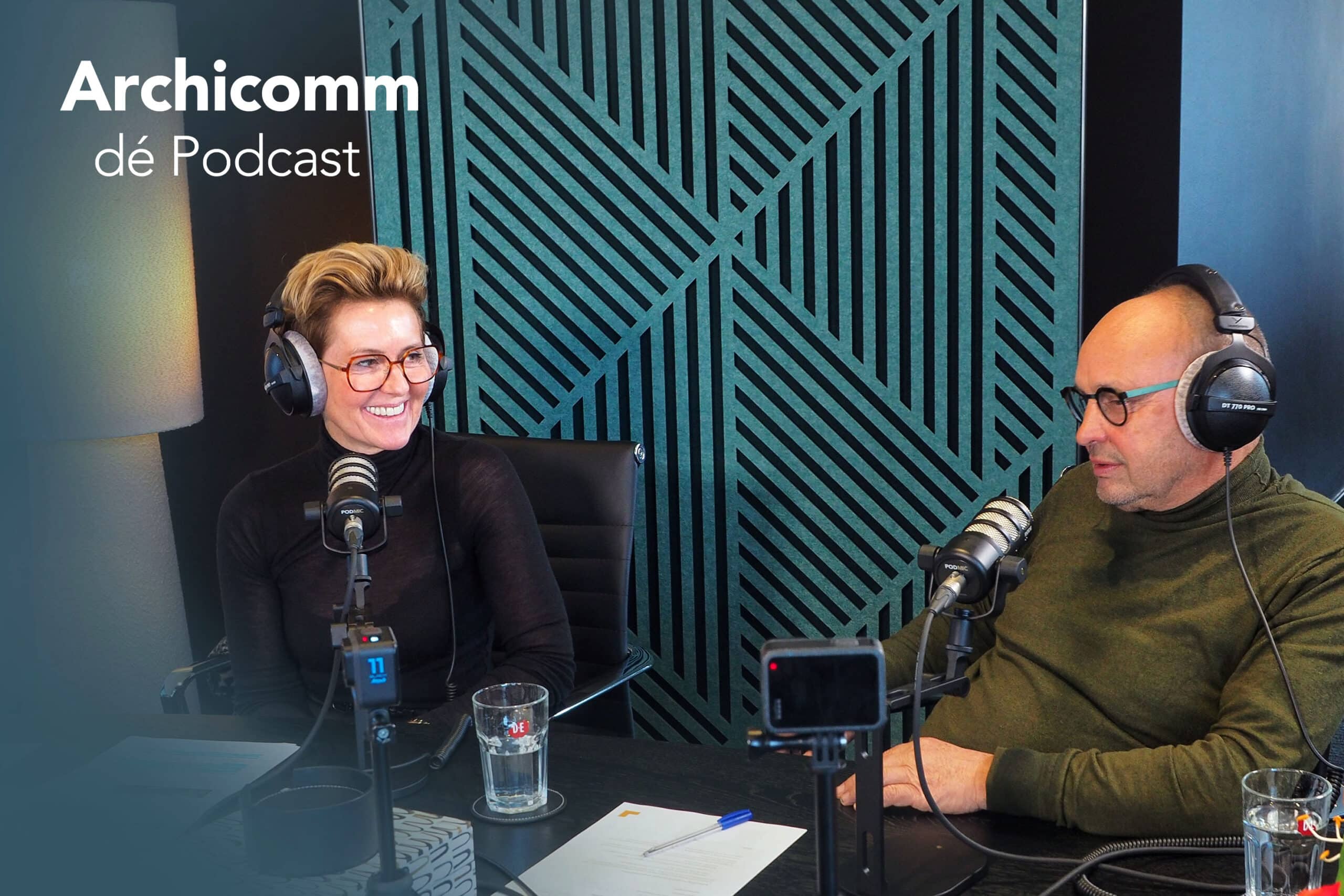
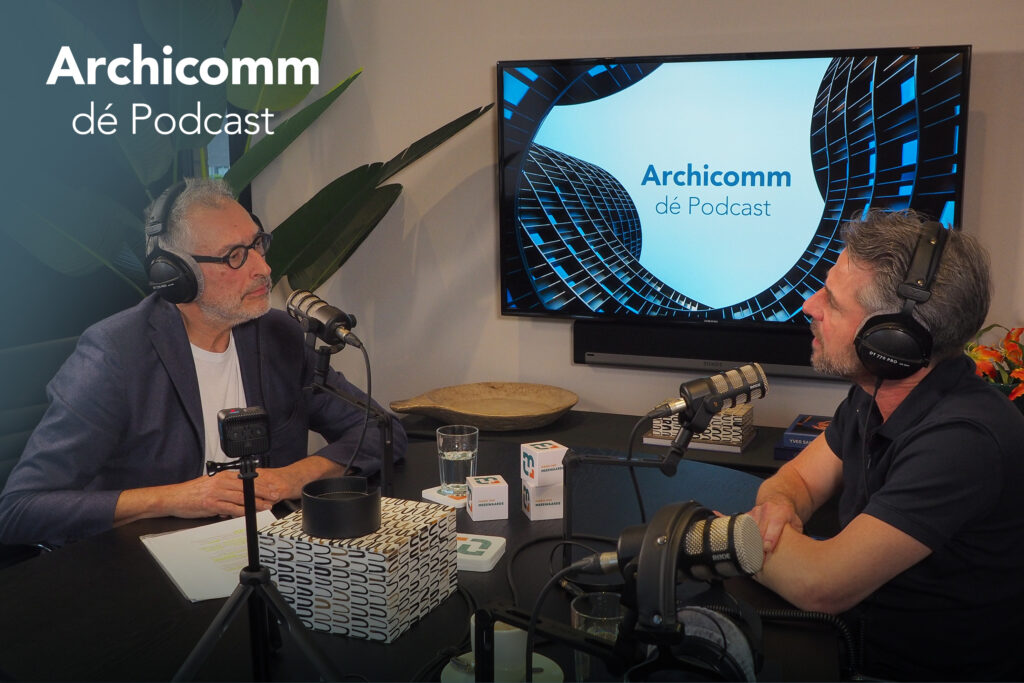
This episode of the podcast focuses on the conversation with Dirk Mattheeuws, president of Netwerk Architecten Vlaanderen. Together with the host, the question: how do you find the right architect? Dirk shares his insights from his years of experience within the architecture sector and his role as a connecting figure between architects and clients.
He emphasizes that choosing an architect goes far beyond mere style or budget. According to him, a successful building process starts with a good click and mutual trust. After all, an architect is not only a designer, but also a guide through an often complex process of regulations, planning and execution.
During the conversation, it becomes clear how important communication is. Dirk explains that open dialogue and clear expectations are the basis of a successful collaboration. The importance of a clear vision is also discussed: what do you as client really want to achieve and which architect matches this in terms of content and personality?
In addition, he discusses the role of Netwerk Architecten Vlaanderen in supporting quality and professionalism within the sector. The network encourages knowledge sharing and collaboration, which ultimately benefits the builder as well.
The episode offers practical tips for those looking for an architect. From looking at reference projects to conducting exploratory interviews, a thoughtful choice prevents disappointment later.
With clear examples and nuanced insights, Dirk Mattheeuws makes it clear that finding the right architect is no accident, but the result of a conscious and well-informed choice.
Archicomm Dé Podcast - Episode 2026/2
Host: Patrick Return
Guest: Dirk Mattheeuws
[00:02] Part 1 - Introduction, NAV and the role of Dirk Mattheeuws
Patrick Retour: Welcome to the second episode of Archicomm Dé Podcast, year 2016. My name is Patrick Retour and I am your host and host on duty for Archicomm Dé Podcast. I also provide reports for Archicomm magazine.
Patrick Retour: Today we ask the question: how do I find the right architect? And how do I find the architect with the right skills who is going to guide me through the building process, who is going to relieve me of all the building stress? And for that we turn to our guest today.
Patrick Retour: That's a seasoned architect who is also president of NAV, Netwerk Architecten Vlaanderen. A warm welcome to our studios, Dirk Mattheeuws. Hello, thank you. NAV, Netwerk Architecten Vlaanderen, what is that thing and
Dirk Mattheeuws: What do you all do? We are a professional association and we actually try to assist architects in their professional practice or profession. To be clear, we are not a professional institute or order.
Dirk Mattheeuws: That's why in Belgium we have the Order of Architects. You have to be registered with the Order of Architects in order to practice your profession. Not with a professional association, you are a voluntary member. So we also depend on the membership fees of our members.
Dirk Mattheeuws: We currently have about 3,500 agencies, independent one-man agencies, but also larger agencies as members. And they actually represent about 6,000-, 7,000 people.
[01:26] What architects can turn to NAV for
Patrick Retour: What can they come to you for then?
Dirk Mattheeuws: Well, we are a networking organization on the one hand. We call ourselves the largest community of architects in Flanders. Actually, we can say that in Brussels and in Belgium. And we do that in different ways. On the national level, we have kind of sub-communities: Women in Architecture, but also Starts and Starters. And then we have a regional operation. In every province now we have a regional operation where architects in the region, divided according to the provinces, can actually do networking. They get together and actually sometimes try to complain there about the profession of architecture. In addition to that networking, we actually do advocacy. That means that we go to politicians, to policy makers, but also to departments, to cabinets, to discuss new legislation. Or existing legislation where there are problems, we will discuss that. And then I think, in addition to that networking and advocacy, a third point that is also important is of course our knowledge sharing, where we provide training and the like, but also make available online an important knowledge database for architects.
[02:44] Target audience: from startups to agency leaders
Patrick Retour: And then, of course, beginning architects in particular benefit from that.
Dirk Mattheeuws: True. It goes for all architects, both indeed beginning architects, trainees, employees, but equally the administrators, the entrepreneurs.
[03:00] Dirk Mattheeuws on his own practice and trainings
Patrick Retour: You are also an architect and director of ARW Architects from Merelbeke-Melle. To what extent does your work help to create a
Dirk Mattheeuws: better to be president? Indeed, I still have a professional practice in Merelbeke-Melle, that's right. I started, graduated in 1995 as an architect. I did my internship in 1995 and there my internship master said: new legislation is coming out, VLAREM legislation. And we started following that together. So I actually also have an education in environment, environmentalist. And I combine that today and actually call myself environmental expert. I also took additional training in the years since. I took safety coordinator training, demolition expert training, asbestos expert training, most recently asbestos expert inventory training, among others. I've always enjoyed actually taking additional training courses over time. And I think that experience also contributes to my presidency of NAV. So I'm kind of familiar with all the, among all the stabs, professional related branches of the architectural profession. We do it, don't practice it anymore. So what we only do in the office anymore is effectively architecture and environment. Everything else is actually outsourced. But I do have the knowledge and it's kind of helpful that we know something about that anyway.
[04:26] Human and environmental practice
Patrick Retour: People and the environment, of course we're all interested in that these days, because that's already under pressure with global warming, with water management that needs to be in order, insulating a lot, consuming less, putting our finger on the purse strings in terms of energy consumption, watching over our wallets. Yes, that can come in handy.
Dirk Mattheeuws: Yes, right.
[04:42] Third activity: external environmental officer
Dirk Mattheeuws: As I said, all that training certainly contributes to my job as president. But I also have a third activity. I also get to be an external environmental officer in a Flemish municipality. You know: environmental officer, bottleneck profession. Today a lot of those positions are filled by consultants, external consultants. And so that's what I am. So I still give advice on the other side as an external environmental officer. The two of course add value to that presidency.
[05:33] Combining tasks and team organization
Patrick Retour: Combining so many tasks, you just have to do it. How do you do it?
Dirk Mattheeuws: I have a good team in the office. There are nine of us, one of whom is me. There are three architects there, one of whom is an intern. There is also a full-time employee environment. And then there are actually two interior architects as well. I'm a space designer, I'm not an interior designer. I think that's also a specialization in itself. And so they take care of the interpretation, the interior side of our profession. And in addition to that, I have two freelancers, environmentalists. They jump in for the environmental part. We especially want, certainly to companies, to professional applicants, to offer a kind of total package and to take care of all the worries, despite that administrative burden that's there anyway today. So in that area a lot is delegated to the employees.
[06:31] Mandate as NAV president
Patrick Retour: Since when did you actually become president of NAV and how long does such a mandate run?
Dirk Mattheeuws: Well, I can already say: it's almost over.
Patrick Retour: And how do you get elected as president for that? How does that work?
Dirk Mattheeuws: I was elected in February 2020. Then we had both a new president and a new director. In March, our new director, Steve Lano, joined NAV, if I may say so. How do you get elected? There were two candidates and at the general meeting the board members elect someone from among the candidates who presented themselves. Hopefully this will occur again at the next general meeting, because my maximum term of two times three years is up. So in April 2026, I hope that a number of candidates will come forward again so that we can then have another election and a successor.
[07:31] Limitation to two terms
Patrick Return: As with the president of America, a third term is no longer possible.
Dirk Mattheeuws: No, and actually I think that's healthy.
Patrick Retour: Yes, yes.
Dirk Mattheeuws: It's good that a new wind is coming. It's allowed.
[07:42] What changed since 2020?
Patrick Retour: What have you pretty much accomplished as president, if you could sum that up in a nutshell? Or what new winds have blown since you've been there?
Dirk Mattheeuws: I think a lot of that depends on the duo or the cohesion between chairman and director. I think we really did play off each other and we really did get quite far with new legislation, with new things that we realized. Today NAV is asked when new legislation would arrive. People used to not know how to find us enough. I think that today we can say that we are known, that people know where to find us when it comes to new legislation. We have also moved. We also looked for a new office in the last three years. A new office in Ghent has been set up. So yes, there is anyway ... NAV looks different. I am convinced that NAV looks different since 2020.
[08:38] Word of mouth and visibility
Patrick Retour: Dirk Mattheeuws, is definitely a good chairman in my opinion.
Dirk Mattheeuws: I hope so. After April, maybe I will be seen that the result is effective.
Patrick Retour: Okay, then we'll speak some time. Dirk, you do have an architect at the table who said to me: as an architect, I never actually advertise. I live by word of mouth. The facades of my houses, that's actually my business card. And people see a house that I have realized. They ring the doorbell, they ask how the cooperation was with the architect. Or they put a bill in the bus. They ask: Who is the architect you worked with? That may go for someone who has already realized a lot, but beginning architects may not be able to work that way. Yes, what do you have to say to that? He didn't think it was necessary to make himself known. The client did find him.
Dirk Mattheeuws: I can agree with that a little bit. I've never had a bill in the mail, that hasn't happened to me yet. But it is true that actually most customers come through word of mouth. And then it is convincing about what you have achieved in the past. In that area, I have sometimes, dare I say, been a problem solver. That's why quite a few, when it comes to environmental files, complex files, come to us. But so it's true: a lot of word of mouth. I haven't had a website for four years since 2019, I think. Since this year, we launched a new website. I did not have a website for a while, because indeed it was not a priority and because there was actually enough work from that word of mouth. But in the meantime, we have a new website. I am actually happy that we have a new website, the employees are also happy with it. It does give naturally ... you can introduce yourself. It's a different approach. So the website is actually a positive evolution.
[10:46] Part 2 - Beginning architects, online search and the match
Patrick Retour: So of course they do: beginning architects sometimes complain that there is too little work on the shelf. Maybe there are too many or they have not been able to prove themselves yet enough, are then less in demand. What would you advise beginning architects to do? And how can NAV play a role in that in terms of support?
Dirk Mattheeuws: Well, I would immediately refer to our website, “Find an Architect.” You can actually post projects on there. They can be small projects. You can just as easily post studies on it. As a beginning architect, you can actually post studies on there as well. It doesn't have to be realized projects. You can also put impressions on there. But if you are a member of NAV, then on that “Find an architect” profile you can create a profile, then you can post projects and on certain search terms builders can then find you.
[11:35] Online search and pitfalls
Patrick Retour: Yes, driving around now may be of all times. It can be a tourist trip, going house hunting, but obviously these days we're going to be looking mostly on the Internet highway. What are the obstacles there, the pitfalls when the consumer goes looking on the Internet for architects? Yes, what should they look out for? What should he look out for? Again, that would
Dirk Mattheeuws: builder back again our website of course, “Find an architect,” very helpful. I think it makes sense for builders to search online first and foremost. But then I would still recommend searching a little bit in the neighborhood. You can also search by municipality and then just see which architect in your area you like. You then visit the individual websites. I wouldn't do too much searching there either. I think we have the experience as architects by now: if building owners are going to shop around too much and actually honestly admit, if I get a general mail in where I feel it's sent to ten or to fifteen architects, it's not going to motivate me to respond. After a while you may not see the forest for the trees. So I would say search online, narrow it down to a few architects in the area. Then possibly make an appointment with those.
[12:50] Practical benefits of working in the region
Patrick Retour: Yes, as green editor I also come into contact with landscapers and garden contractors a lot. And I also hear from them that they like to stay in the region. To, of course, avoid expenses in terms of transportation, standing in traffic jams. That's not a profitable use of time. So to see there a little bit also that they can work optimally. Maybe that also applies to the architect you need. If he lives around the corner, is from the region, does work a little easier.
Dirk Mattheeuws: It's absolutely right. We have evolved into an agency that works all over Flanders. We still have some projects in Wallonia, some projects in Brussels. I think I do 35,000 to 40,000 kilometers a year. If I could curtail that, I would be very happy with that. So that would be okay. So it's preferably indeed close by. It's always convenient. As far as architects are concerned, of course, if you take an architect from the neighborhood, they may also know a number of references of contractors in the neighborhood. And of course if you have a number of contractors that you are familiar with, know that they do good work, then of course it's convenient that you can go ahead and realize the project with contractors from the neighborhood as well.
[14:06] Style, references and preparation by the builder
Patrick Retour: As a customer, you also have to do a little research, I think. Images also capture the imagination. You go off of references, you might make a mood board. You're going to establish somewhere for yourself what style of living, of life you have. And then you're going to see if there's a match with an architect like that, I suppose.
Dirk Mattheeuws: True. You have all kinds of tools online today, Pinterest or mood boards. AI can already help a little bit, very much so. So you can think of all the ways to work imaginatively and actually start expressing your ideas already a little bit to the architect. But I think that appointment is still important.
[14:50] Living dream, relief and click
Patrick Retour: Ultimately, the goal is to realize a living dream. And that's where the role of the architect is very important. So it's well worth paying attention to that and taking the time as a consumer to really do that search successfully.
Dirk Mattheeuws: True, and it also has to click. I think that's an important aspect. It's not just about what you see on a website. I think that besides conformity to imagination or to images, that there has to be some kind of personal click and a business click. The personal click is about creativity: are those common, or expectations in terms of creativity, in the same direction? But of course, an architect is more than a designer. He also, of course, has to realize that design, and for that there has to be a business side as well. So the budget must be right, the budget must also be respected and it must be tendered. It has to be realized. It is not just a dream. It has to be realized.
[15:56] Complexity and liability
Patrick Retour: The complexity of the profession did increase even more and that does require attention, of course.
Dirk Mattheeuws: Not only the complexity, but also the consequences of that complexity, the liabilities, are huge as an architect. But that's where NAV might be a bit of a safety net as well. Right, very much so. And we always try to bring that forward, how complex it has become. Recently also in discussions about compensation. And not just remuneration for companies, but certainly also for young architects. Everyone in the sector must of course be paid fairly and correctly. And of course that story of liability, of complexity, is certainly part of it.
[16:39] Next step after selecting an architect
Patrick Retour: Then suppose I have set my sights on a woman or man, architect, who I say I want to work with. What is the next step? First you make an appointment to get acquainted, to put our heads together. And how does that proceed?
Dirk Mattheeuws: Well, I would say: if the personal click and the business click is there, then I think you should come to a good price agreement. The price agreement is not always obvious. With price agreements, of course, the assignment has to be clear. And there we see some issues: that the client has not always completed his assignment, or has not always clearly defined the assignment. And then it is not so obvious to be able to make an offer right away.
[17:33] Test assignment and feasibility study
Patrick Retour: Is it a good idea to give an architect, or two architects, some kind of test brief? Look, make me a sketch, do a feasibility study. And then to see if afterwards the paths separate, if you continue together on the same path anyway. Is that an idea? And is that free? Or does it come with a price tag, just like any consultation with a doctor?
Dirk Mattheeuws: We do that effectively. So we have some assignments going on now where we have some kind of preliminary assignment. That doesn't necessarily have to be with two architects. It can also be with your architect that you've chosen. Where you give an introductory brief. That introductory brief, an example I can give right now, is an introductory brief for a new construction office with commercial building, where the introductory brief runs to an initial review with the municipality. We kind of make a form study, an organizational chart, program. A kind of first building proposal is conceived and the idea is that this is now submitted to the municipality and then we'll see: if that is found to be positive for the municipality, then the project can go ahead. And this is indeed a feasibility study. It is not unusual to do this.
[20:40] Part 3 - Honors, contracts, communication and closure
Patrick Retour: Do you sometimes feel that the job of an architect is undervalued, that it should be upgraded? A bit of a sensitive question, but yes. Because it is often hard work, I think. When I see what kind of care they all have to lift on their shoulders. It's easy to say: the architect will fix it, and he has to fix it. He has to steer it all, direct it, delegate it, make sure there is good cooperation with all the actors, take care of communication to the client. There is a lot involved.
Dirk Mattheeuws: I don't know if it's a sensitive question. I think it's a pertinent question. The job has evolved. We are no longer “Mr. Architect,” as it used to be, like “Mr. Doctor” and “Mr. Notary Public.”.
Patrick Retour: But a lot is expected.
Dirk Mattheeuws: There are huge expectations. We've already talked about it. The liabilities are enormous. The profession has also become very complex with so many separate cases, so many cases added, so many standards. The 1939 law is actually not geared to how the profession is now. We have the traditional triangle, we also developed a vision around that at NAV. We would rather see the traditional triangle of contractor, client and architect evolve into a team, where the architect can still be the director of the overall team, but where all members of the team take responsibility for their part. Instead of a safety coordinator, the safety manager, so to speak, the ventilation reporter, ventilation designer,
Patrick Return: and where that indeed everyone for his share obviously takes responsibility with the accompanying liability. Is that also something that you are working on with NAV? That architects get extra skills? How do you tackle that?
Dirk Mattheeuws: Right, we're definitely pushing for that. We provide training for that. All kinds of trainings that are also sometimes repeated. So on the one hand the trainings, but on the other hand we also have the help desk. You can call NAV for first-line advice if you are a NAV member.
[22:49] Purpose of NAV
Patrick Retour: So with NAV, we get better architects, right? That's the idea.
Dirk Mattheeuws: Yes, some better architects. The intention, on the one hand, is to really do take care of them as well, provide assistance in the profession and make sure that they can do better in the profession, improve the profession and hopefully with that, better architects.
[23:14] Contracts and legal advice
Patrick Retour: If you then make agreements with an architect: yes, good agreements that have to be put into a contract and then again that price tag is attached to it, that has to be agreed very clearly. Such a contract and legal assistance, is that also something NAV is betting on, where one can go?
Dirk Mattheeuws: I think that's more something for our insurance companies. Usually when it comes to legal assistance, I listen to the insurance company. They are more likely to give advice. We are not lawyers either. We have to be careful not to formulate legal advice to our clients either. As architects we should refrain from doing that. So when it comes to legal advice, be it in our own contract, but also in the contract for example with the contractor, it is important that we do not interfere, because we are not lawyers, we remain architects. So our advice is always technical in nature and not legal in nature. NAV can certainly advise you on that. They know where the standard contracts are for the different insurances. They then refer to that. But if it is specific legal advice in the context of my potential liability, I will still refer to the insurance here.
[24:29] Communication as key
Patrick Retour: In any case, I believe that dialogue and communication is always the key to a successful collaboration. I speak from my own experience. When we have built, remodeled and renovated our bathroom at home, as a customer I also showed a lot of interest towards the architect, towards the men and women at the site. And that was always actually appreciated. That motivated them. I think if people are going to build or renovate somewhere and they're a little short on interest, sometimes that's demotivating. So it comes from both sides. If the architect is motivated, the client is motivated, you can build something together.
Dirk Mattheeuws: Absolutely. I think so. The team remains the triangle of ’39. It remains a game between contractor, client and architect. And the architect should not always side with the client, even if he is paid by the client. He can sometimes be in a position where he becomes a bit of a referee between contractor and client. Communication remains important here. When a job site starts I always say: call before the fire. Make sure you communicate on time, keep communicating, because sometimes mistakes are also made. Keep communicating, whether it's by mail, phone, whatever, but above all keep communicating, because that does matter very much.
[25:49] Unburdening has limits
Patrick Return: Customer should also keep asking enough questions. I've also experienced that myself. Then I ask: yes, how are you just going to do that? If you haven't asked, yes then you come up with the reflection: yes, I didn't know that. But yes, you also might have had to have asked.
Dirk Mattheeuws: True, and unburdening also has its limits. Not everything can be taken over. It is an illusion that you don't have to do anything on that site because you have a contractor and an architect. You will still have to do a lot of effort as a client as well, even if it's just making choices, making decisions. But in the end there will be a lot of construction stress as well, guaranteed. My excuse is for that.
[26:31] Solving together what goes wrong
Patrick Retour: We strive for satisfaction, of course. Yes, always. That's a challenge for a lot of architects.
Dirk Mattheeuws: Sure, but again: something always goes wrong on a job site. And the punch line is that it is then solved as quickly as possible. That the three of us get together on site to look for solutions. And if there is enough flexibility there, because, for example, the contractor straightens things out, then that is not a problem. But there will always be something on site that is different than expected, or what the builder expected. That is not unusual.
[27:08] Small desk versus larger desk
Patrick Retour: Working with an architect who is actually on his own can have advantages, because it's very personal. A larger firm sometimes does have a bit more bearing. What is your experience? What should people choose? Of course, they all need to get on board.
Dirk Mattheeuws: Well, I already said it: it's a choice anyway for mostly someone you have click with. Personally and professionally. And I notice that most of the time people have chosen a person. I also notice that at the office. Sometimes they explicitly ask me to come to the site in person. Even though there is a project architect in our office who has been appointed for the site. But then they still ask again: you do come by in person, don't you?
[27:51] Passion and variety in the profession
Patrick Retour: Yes, with a large agency it is of course also people who make the company, of course. And then again you have that personal collaboration.
Dirk Mattheeuws: Right. And we all do it equally well and equally passionately. But still then sometimes one looks at the figure with whom one made the initial arrangements.
Patrick Retour: What's so great about being an architect, Dirk?
Dirk Mattheeuws: It remains an intriguing, beautiful job. Above all, it is very varied. You've heard it: I have three sets of duties, so to speak. There are three activities and the variety is super interesting. [28:26] Closing
Patrick Retour: I'm going to thank you for coming up here to our studios in Weert, Holland Studios of the Louwers Media Group. This was another episode of Archicomm, Dé Podcast. The fifth already in a row, all available to listen to on Spotify. I would love to hear you back soon for another episode of Archicomm, Dé Podcast. Greetings. Bye.