Platform on architecture, interior design and landscape architecture
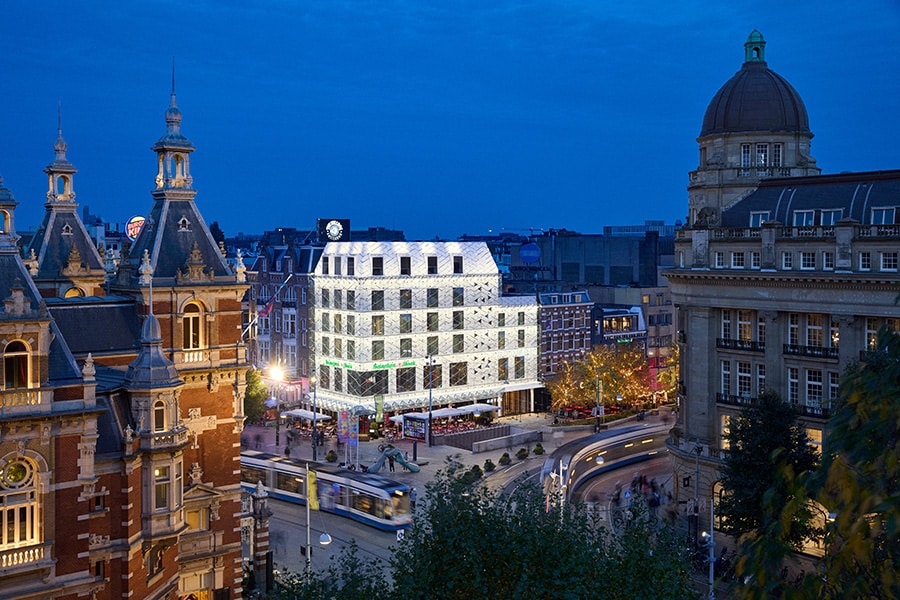
The legendary Heineken Hoek Grand Café has returned to its former location on the corner of Leidseplein in Amsterdam. Between 2022 and 2025, the original, dated building from 1900 will be replaced by a completely new and iconic building, which will house the four-star hotel The Diamond and catering establishments. MVSA Architects opted for a spectacular yet understated design with a transparent curtain wall and canopy in a diamond-like look, which nods to the city's rich diamond history. In combination with the lighting fixtures from Livingprojects, the unique design concept is clearly visible to the surroundings both during the day and at night, without the lighting being disruptive.
The Diamond – Heineken Hoek is a long-term project. Caransa Group and Heineken launched a competition for the project back in 2011, with the aim of giving this inner-city location a quality boost. “The ambition was to create an expressive yet understated building that would integrate a hotel function alongside catering facilities,” explains Wouter Thijssen, architect and director at MVSA.
“We spent quite some time trying to find a suitable design for this. The location in the city center is very dear to the hearts of many Amsterdammers. That's why we drew inspiration from elements that are typical of Amsterdam.” As an example, he mentions the canal houses, which are characterized by a transparent public plinth, a middle section, and a sloping roof. “In the case of The Diamond – Heineken Hoek, we have draped a striking façade over this. A beautiful reference to the famous Koh-I-Nor diamond, which was cut by an Amsterdam master cutter in 1852.”
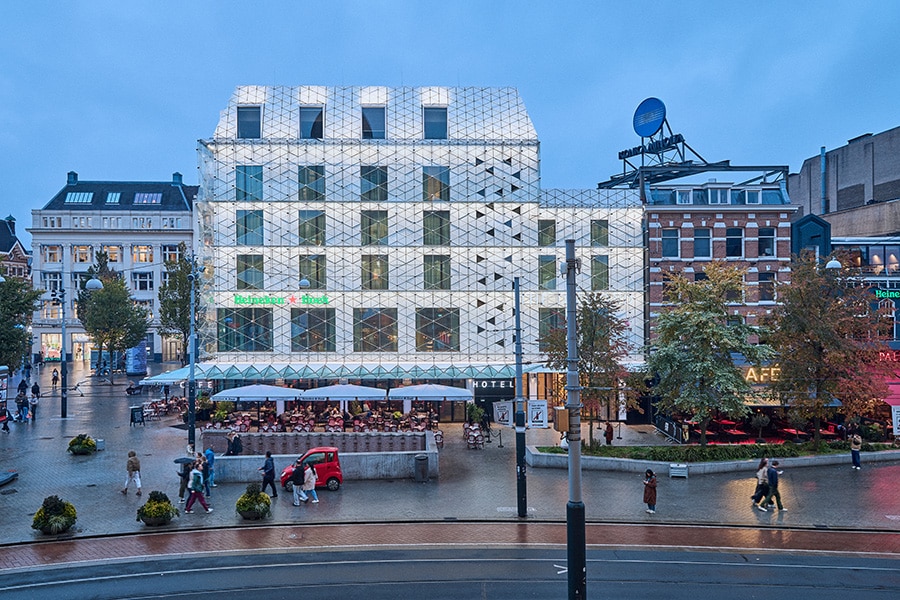
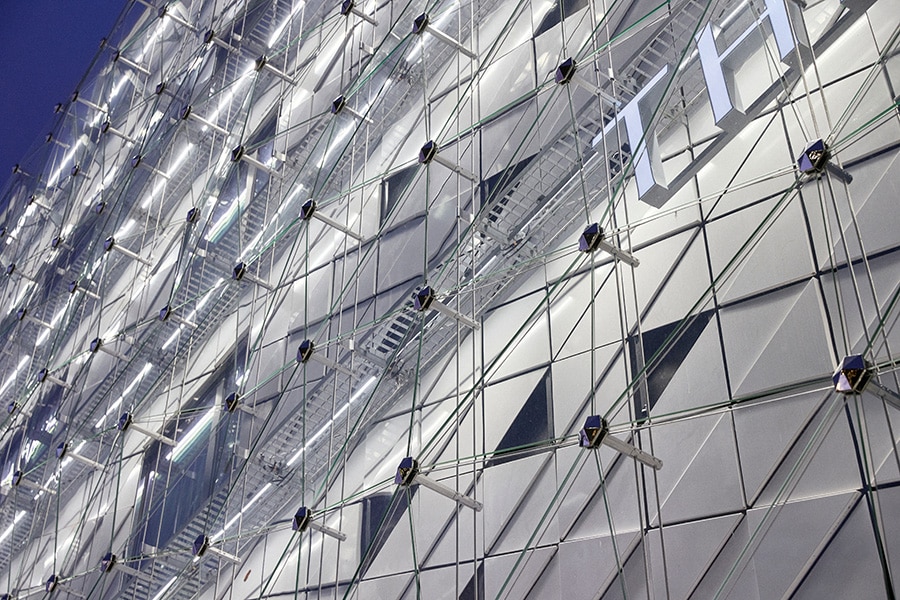
The new The Diamond – Heineken Hoek has six floors and a basement, which blend seamlessly into the streetscape, says Thijssen. “The new building fits in nicely with the surrounding buildings and roof lines, building lines, and roof heights. Thanks to the large glass windows and glass canopy, the building also blends in beautifully with the ground level.” A double façade was deliberately chosen for the façade. “The inner façade (thermal shell) is made of fresh white aluminum with subtle triangular relief patterns, which continue harmoniously into the roof. To this end, a glass outer façade with a canopy was developed in collaboration with Octatube. The aesthetic exterior façade is suspended from the interior façade with steel cables and constructed from triangular pieces of glass, which are mounted at different angles to create a unique and airy diamond effect.” Hexagonal connectors were created at the points where the glass elements meet. “All mounting points are made of shiny stainless steel, giving the façade even more cachet.”
During the evening and night hours, the interior surface of the glass facade is elegantly illuminated by Livingprojects lighting fixtures. The contact between MVSA and Livingprojects was established through Caransa Group, with whom Livingprojects has already carried out several high-profile projects. One example is the Foodstrip in Amsterdam Zuidoost, which features no fewer than 21,000 RGB LED pixels. “In recent years, we have been able to solve several complex lighting issues for Caransa Group,” says Michael Sebregts, founder and CEO of Livingprojects. “Our ambition in this regard is always to make the lighting supportive of the architecture. Close collaborations with architectural firms such as MVSA are indispensable for this.”
“During the preparatory phase, we explored various lighting scenarios together with Livingprojects,” Thijssen explains. “For example, we started with a facade featuring lots of LEDs, which could imitate the image of large glasses of beer.” Sebregts: “We also explored a scenario in which all stainless steel joints were filled with LEDs. However, after further investigation, this proved to be too complex, both in terms of lighting technology and the construction of the façade.” Instead, and at the request of Caransa Groep, a subtle illumination of the façade was ultimately chosen. “But here too, we were confronted with various challenges. Because of the double façade, but also with regard to the uniformity of the lighting, the light color, and the positioning of the lighting points. For example, the guests of The Diamond hotel should not be bothered by our lighting in any way.”
“The project involved quite a few elements that led to a certain degree of complexity,” Sebregts summarizes. “To create an even light image, the lighting was applied in multiple layers. This meant we had to deal with the grating floors for window cleaners, for example, which caused unwanted shadows. We also had to take the hotel windows into account. We carried out various lighting calculations and practical tests to determine the right types of fixtures, installation depths, light colors, and beam angles, and to prevent a disruptive ‘zebra effect’. The mock-up of part of the facade was very useful in this regard,” says Thijssen. “Based on this, we were able to further fine-tune the wattages and directional angles, for example.”
Philips“ architectural UNI luminaires ultimately emerged as the most suitable solution and were custom-made for this project. ”In total, we supplied around 200 luminaires, including documentation on the correct electrical and data connection facilities,“ concludes Sebregts. ”We also took care of commissioning and programming the luminaires. Each luminaire can be controlled individually. In addition, the light intensity can be adjusted as needed, allowing the lighting to be tailored precisely to the building's requirements at any given moment."