Platform on architecture, interior design and landscape architecture
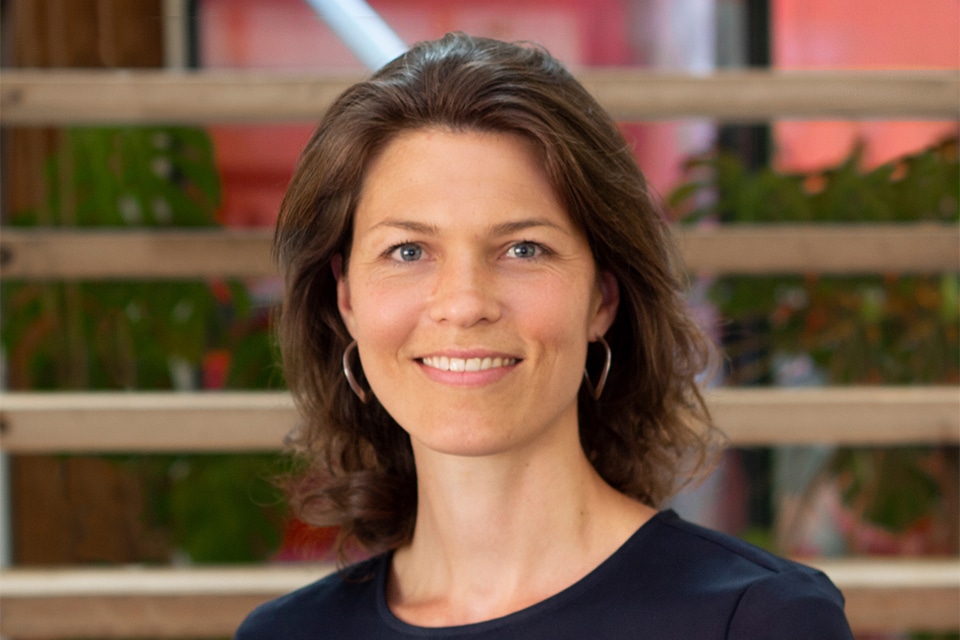
Over the past 10 years, architect Karin Dorrepaal’s perspective on sustainability has fundamentally changed. While discussions in the construction industry often still begin with materials, MPG, or BENG, she now takes a broader view: seeing the site as a living ecosystem. This is not merely a lofty ambition, but a way to evaluate design choices throughout the entire process—especially when time, money, or regulations put pressure on original ideals. “We therefore strive to create added value on both the ecological and social fronts,” she says.
Incidentally, that shift didn’t start out as an abstract concept. As early as its first year, her firm (she co-founded DOOR architects in Amsterdam with Saskia Oranje) built its own workspace using as many secondhand, local, and demountable elements as possible—from shipping containers to floor joists and window frames. Back then, actively seeking out waste streams was still uncommon. Now, that focus on materials is part of a broader vision.
For Karin, regenerative design means that a project begins with the site itself: people, plants, animals, soil, water, air, and materials. Through an ecosystem analysis, her firm identifies elements, flows, and species. She says, “The guiding question is always: How can we leave this place in better condition than we found it?”
This question is explored through six flows or cycles: energy, water, biodiversity, food, materials, and social issues. As a result, spatial choices, use, and management are inextricably linked to biodiversity and social value. Karin emphasizes that sustainable architecture does not necessarily have to have a recognizable style. “You can make something look ‘green’ and yet design it in an ecologically poor way—or vice versa.”
To maintain that coherence, DOOR Architects developed the Flourish Framework, inspired by research conducted by Nancy Boken, Laura Niessen, and Samuel Short of Maastricht University. The framework consists of five circles: efficient, net-zero, circular, regenerative, and flourishing. The last circle is particularly significant, as it prioritizes social and ecological well-being over financial profit. “For us, sustainable architecture is more of an attitude and a process than a style,” she explains.
It is precisely in practice that such a framework is needed. According to Karin, the focus in projects often reverts to what is easily measurable. Lower MPG scores and better BENG performance are important, but they primarily fall within the efficiency circle. “Protection and restoration require interventions in the larger circles: regenerative and flourishing. The risk arises mainly during design fixation, the bidding process, or budget cuts. That’s when ambitions quickly become mere ‘scope,’ unless they remain visible.”
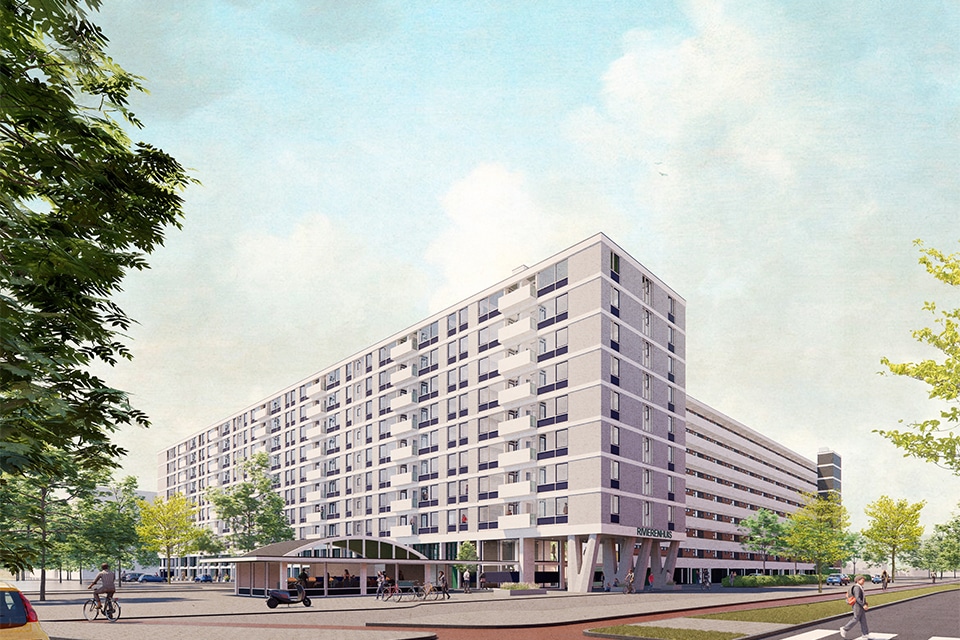
Karin has an example. “During the renovation of the Rivierenhuis for Eigen Haard, the budget was under pressure due to the price cap on social housing. However, using a comparison matrix that ranked costs, CO₂, and comfort side by side, bio-based Faay walls came out on top. In fact, the choice became even clearer, because the walls are not only more sustainable but also faster to install.”
Another key step forward was the collaboration within the supply chain. From the very beginning, the contractor, demolition contractor, architect, co-creators, and suppliers worked together. This ensured that circular materials and reuse did not remain isolated project goals but could be scaled up. That is why the architectural firm is also sharing the framework with others. “If we all operate within the same broader framework, we can scale up more quickly from achieving targets to creating thriving living environments.”